Professional Parking Lot Striping: A Complete Guide
At 7 a.m., a property manager in Dallas–Fort Worth can already see the problems in a busy retail lot. Wheel stops disappear into faded yellow paint, directional arrows barely register from the entrance, and an accessible space blends into the asphalt. By lunchtime, drivers are choosing their own lanes, pedestrians are cutting across moving traffic, and the lot looks older than the building it serves.
Professional parking lot striping fixes more than appearance. It restores the layout drivers depend on, supports accessible parking compliance, improves wayfinding, and gives property owners a practical maintenance schedule. In DFW, intense sun, hot pavement, traffic volume, and sealcoating cycles make striping a recurring operating decision rather than a one-time cosmetic project.
Table of Contents
- What Professional Parking Lot Striping Really Means
- Why Fresh Striping Pays Off for Property Owners
- Materials, Paint Types, and Standard Line Geometry
- ADA, MUTCD, and Local DFW Code Considerations
- Typical Pricing and What Drives the Cost
- The Striping Process From Prep to Curing
- Choosing the Right Striping Contractor
- Maintenance, Re-Striping Schedules, and Final Takeaways
What Professional Parking Lot Striping Really Means
A professional crew doesn't arrive with a spray machine and paint over whatever lines remain. The work starts with a site review. The contractor checks the existing stall pattern, drive aisles, fire lanes, crosswalks, stop bars, arrows, wheel stops, drainage, pavement condition, and accessible spaces before deciding whether the old layout still makes sense.
Layout comes before paint
Parking lot striping is the planned application or re-application of pavement markings. Those markings can include stall lines, directional arrows, pedestrian crossings, curb warnings, fire lanes, no-parking areas, accessible symbols, and border lines. A reliable layout gives every marking a job. White generally separates spaces or traffic moving in the same direction, yellow communicates opposing traffic or restrictions, and blue identifies accessible parking functions under widely used U.S. conventions, as outlined in this parking lot striping geometry guide.
A quick restripe follows an existing layout when the stalls are usable and the circulation pattern still works. A redesign is different. The contractor recalculates stall placement, row ends, turning paths, accessible-space locations, aisle relationships, and traffic flow. Repainting an incorrect layout only makes the wrong answer brighter.
Practical rule: Striping is layout engineering first and paint application second.
DFW pavement needs a maintenance plan
Dallas–Fort Worth heat and ultraviolet exposure can cook pavement markings, especially on high-traffic retail lots and unshaded asphalt. Sealcoating can also cover existing lines, so the work needs to be sequenced rather than scheduled in isolation. A property manager who treats striping as part of the pavement maintenance calendar will make better decisions than one who waits until every marking has disappeared.
The history of standardized pavement marking helps explain why this matters. Centerline markings are widely traced to Michigan in 1911, and the first national traffic-control standard, the MUTCD, was published in 1935. The FHWA published the 11th Edition of the MUTCD on December 19, 2023, retaining and updating pavement-marking requirements in a modern regulatory framework. Professional striping therefore sits inside a long tradition of consistency, safety, and wayfinding, not merely property beautification.
The rest of the job depends on details owners can verify: why visible markings affect operations, how materials and geometry shape the quote, how ADA and MUTCD requirements interact with DFW rules, and how preparation and maintenance determine service life.
Why Fresh Striping Pays Off for Property Owners
Fresh markings solve problems in the order owners usually feel them. Drivers follow clear arrows more confidently, pedestrians can identify intended crossing areas, and vehicles settle into defined stalls instead of improvising around faded lines. That won't eliminate every collision or conflict, but it removes avoidable ambiguity from a busy property.
Safety and traffic flow
Start at the entrances and watch where drivers hesitate. If arrows are missing, row directions become unclear. If crosswalks have faded, pedestrians choose the shortest route, even when it crosses an active aisle. If stop bars and fire-lane markings have disappeared, drivers and responding personnel lose visual cues that should be obvious.
Clear stalls also help a property use its paved area more efficiently. A consistent layout reduces awkward parking, improves circulation, and keeps drive-thru approaches and tenant entrances moving. The benefit is operational, not theoretical. Customers spend less time decoding the lot and more time reaching the business they came to visit.
Appearance and property perception
A clean exterior influences how people judge a property before they enter it. Industry guidance identifies professional striping as a way to improve safety, organization, curb appeal, and the perceived care given to a commercial site. That matters in DFW retail centers, where owners compete for tenants and customers notice neglected pavement quickly.
Exterior cleaning supports the same value signal. A 2024 real-estate analysis based on more than 100,000 home sales reported that professional exterior cleaning can increase resale value by about 7%. The finding concerns homes, not parking lots, but the principle carries into commercial property management: clean, maintained surfaces can strengthen first impressions. Other market guidance places curb-appeal effects in the 5% to 11% range, while a UK guide reports a perceived-value addition of roughly £13,400 on an average property when curb appeal improves. These figures come from separate property and exterior-cleaning analyses, so they shouldn't be treated as a guaranteed return for striping alone. See the exterior-cleaning value analysis and the curb-appeal discussion.
| Benefit of Fresh Striping | Risk or Cost If Ignored |
|---|---|
| Clear arrows, stalls, and crosswalks | Confused circulation and more pedestrian conflicts |
| Visible accessible symbols and aisles | Compliance exposure and rework |
| Defined fire lanes and stop bars | Obstructed emergency routes or weak traffic control |
| Uniform rows and borders | Lower curb appeal and a neglected appearance |
| Documented maintenance | Harder defense in a claim or inspection |
A faded handicap symbol, fire lane, or stop bar can become part of the documented condition after a collision, complaint, or slip-and-fall claim. Fresh striping isn't a substitute for sound pavement, lighting, signage, or safe operations, but it is inexpensive risk control per stall compared with the disruption of a complaint, lawsuit, or lost lease.
Materials, Paint Types, and Standard Line Geometry
A DFW striping crew usually chooses material based on pavement condition, traffic, weather, recoat compatibility, and the owner's maintenance cycle. Brand names matter less than correct surface preparation, film thickness, application technique, and reflective performance.
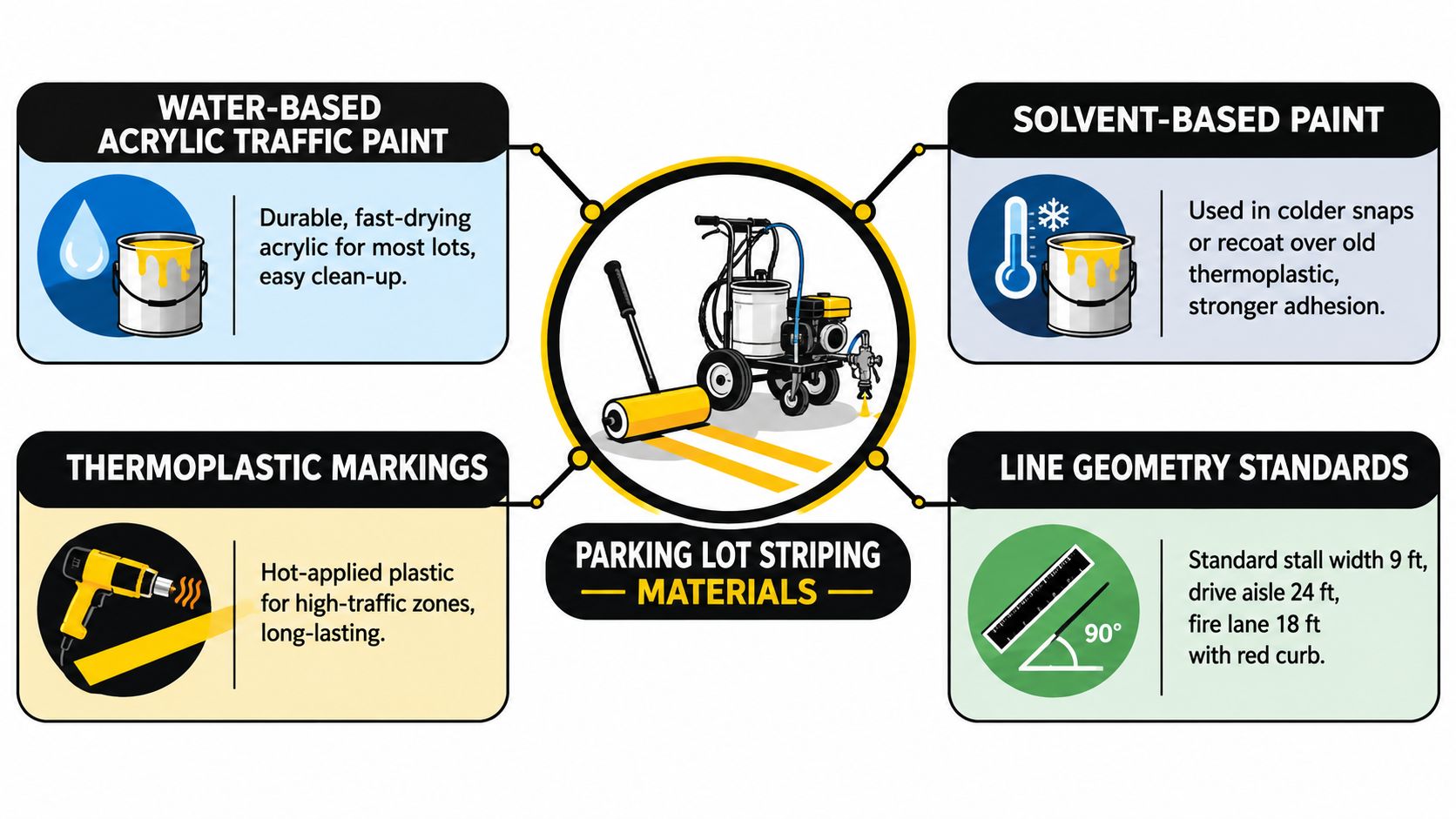
Water-based acrylic traffic paint works for many standard lots because it dries quickly and cleans up easily. Solvent-based products can be useful during colder snaps or when adhesion over older thermoplastic requires a different chemistry. Chlorinated rubber is more suited to high-wear industrial environments. Thermoplastic and methyl methacrylate, or MMA, cost more but can make sense in high-traffic zones, arterial approaches, and large big-box pads. Preformed tape is useful for arrows and symbols that need a uniform shape and can withstand repeated abuse.
What the crew is measuring
Paint thickness, usually specified around 15 to 20 mils wet, affects coverage and durability. Glass beads improve retroreflectivity, which matters when drivers need to see markings at night or during poor weather. The FHWA maintains regulatory guidance on pavement-marking visibility and retroreflectivity, including a 2022 final rule and the 2023 MUTCD update, in its pavement-marking regulations and standards.
Geometry controls both usability and pricing. A common standard stall is about 9 feet by 18 feet, while compact spaces are about 8 feet by 16 feet. Stripe width is typically 4 inches, and that convention gives contractors a consistent basis for layout and material estimates. Accessible spaces require their own review, including access aisles and symbol dimensions.
A quote should account for the number of stall lines, row lengths, arrows, symbols, crosswalks, curbs, and fire-lane markings. More lineal footage means more material and labor. More symbols mean additional stencil setup and application time. Complex islands, irregular row ends, phased closures, and a redesign increase layout labor even when the lot's total area doesn't change.
For a closer look at commercial pavement marking options, review pavement marking services.
ADA, MUTCD, and Local DFW Code Considerations
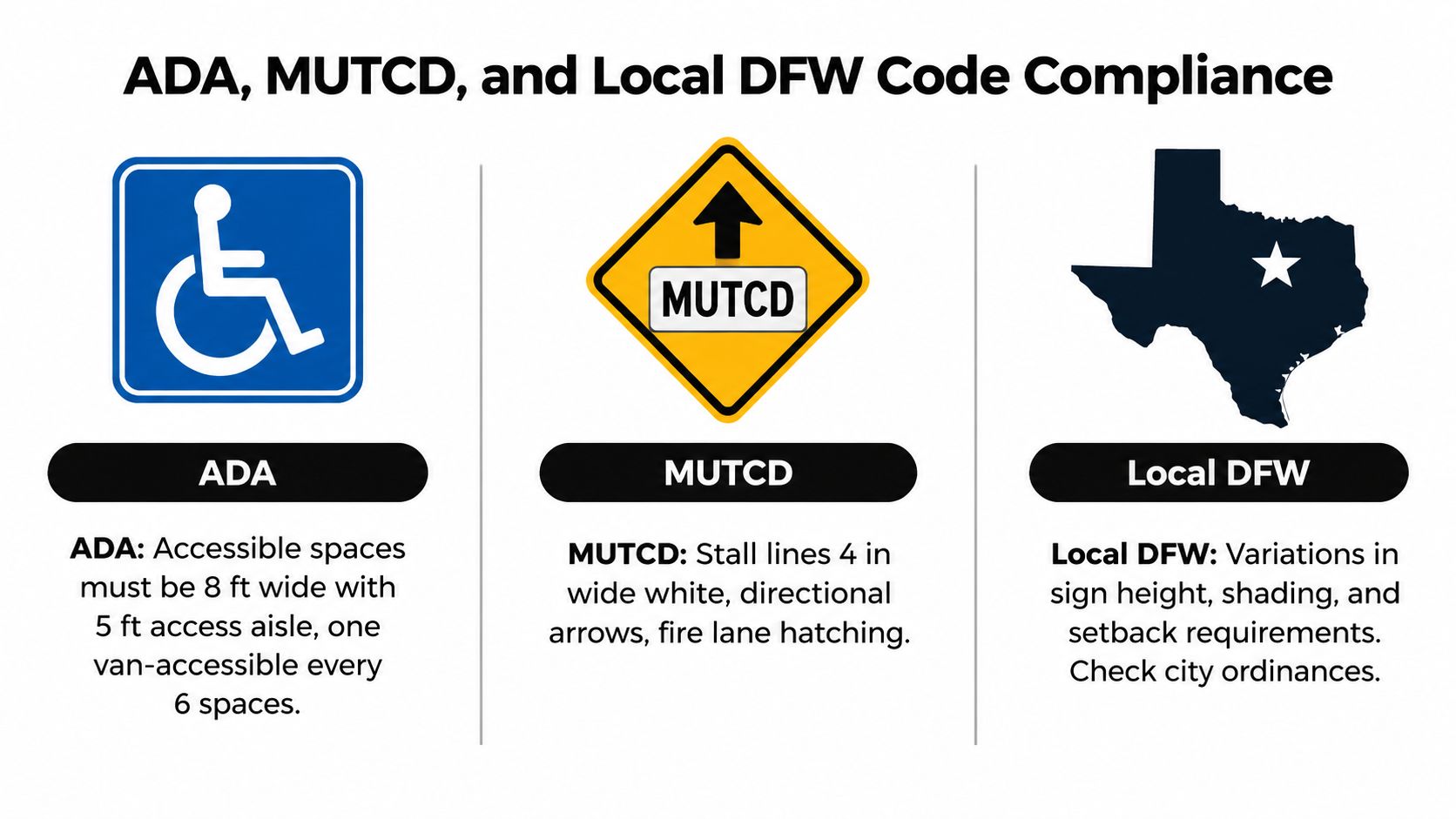
A Texas parking lot can be governed by three overlapping layers. The ADA Standards address accessible spaces, access aisles, routes, slopes, and signage. The MUTCD establishes national traffic-control conventions for pavement markings and signs. Local DFW jurisdictions add permitting, inspection, fire-access, curb, and site-specific requirements.
The accessible-space count is the first item to verify. Counts apply facility by facility, not automatically across every lot owned by the same business. When a business or government agency restripes, the U.S. ADA guidance says it must provide the accessible spaces required by the 2010 ADA Standards. That makes a mixed-use property, phased renovation, or multi-lot campus a documentation problem as much as a painting problem. Use the official ADA guidance for restriping parking spaces before approving a layout.
Verify the field conditions
Don't rely on a faded symbol to prove compliance. Check the total spaces in each parking facility, accessible-space locations, van-accessible provisions, access-aisle geometry, route to the building, slopes, curb ramps, and signage. The MUTCD specifies accessibility-related marking dimensions, including a minimum or standard 28-inch International Symbol of Accessibility and a 41-inch special size, according to FHWA guidance.
Local rules can affect fire lanes, curb colors, stop bars, crosswalk treatments, sign placement, setbacks, and reflectivity. A city inspector may look at conditions that a generic national layout misses. The contractor should confirm the jurisdiction, property use, permit history, and any site-plan conditions before the crew paints.
ADA exposure is material. Recent compliance guidance cites first-violation penalties of up to $75,000 and repeat violations of up to $150,000. Those figures appear in the referenced industry guidance, but an owner shouldn't assume a particular penalty will apply automatically. The practical lesson is simpler: an incorrect accessible-space count can create a much larger problem than the cost of measuring the lot correctly.
Before scheduling: Confirm the facility-by-facility count, van-accessible spaces, sign placement and height, access aisles, route condition, landing slopes, fire-lane markings, and city requirements in writing.
The following video can help property teams visualize the compliance issues that need to be reviewed before restriping.
If accessible layout is a major part of the project, compare the contractor's scope with ADA-compliant parking lot striping services.
Typical Pricing and What Drives the Cost
A useful striping quote should let a property manager see what is being purchased. A single lump sum hides whether the contractor priced a basic restripe, a layout correction, or a full redesign. Compare the number of stalls, stripe width, paint chemistry, symbols, arrows, fire lanes, curb work, preparation, traffic control, and cleanup.
Read the line items
The four main cost drivers are square footage, paint type, layout complexity, and preparation. A simple lot with sound pavement and visible lines takes less layout time than a damaged lot where the crew must measure every row. Sealcoating, crack repair, oil removal, heavy sweeping, and old markings can add preparation labor. High traffic may require night work, phased closures, or weekend scheduling, each of which can change the quote.
Common add-ons include accessible symbols, van markings, directional arrows, crosswalks, fire-lane text, curb painting, wheel-stop painting, and custom stencils. New construction usually costs more than a restripe because the crew must establish the complete layout without reliable existing lines.
The following table is a decision framework, not a fabricated price list. DFW contractors should provide a project-specific range after measuring the property.
| Project Type | Typical DFW Range | What's Included | Main Cost Drivers |
|---|---|---|---|
| Basic restripe | Quote after site measurement | Existing stalls refreshed, standard lines, cleanup | Stall count, surface condition, access |
| Full layout redesign | Quote after layout review | New geometry, circulation changes, accessible-space review, markings | Engineering time, complexity, redesign scope |
| New-construction striping | Quote after plans and field verification | Complete initial layout, stalls, symbols, arrows, fire lanes | Lot size, plan changes, material, scheduling |
For a property-specific estimate, use a contractor's parking lot striping price guide as a starting point, then request a written scope. Ask whether the price includes mobilization, minimum service charges, paint, beads, stencils, traffic control, cleanup, and return visits.
Night work and rush turnaround can carry surcharges because crews must staff different hours and protect wet markings under active-site conditions. A phased lot can also cost more than a closed lot because the crew must mobilize and control traffic repeatedly. The lowest bid often stops being low when missing symbols, weak preparation, or rework appear after reopening.
The Striping Process From Prep to Curing
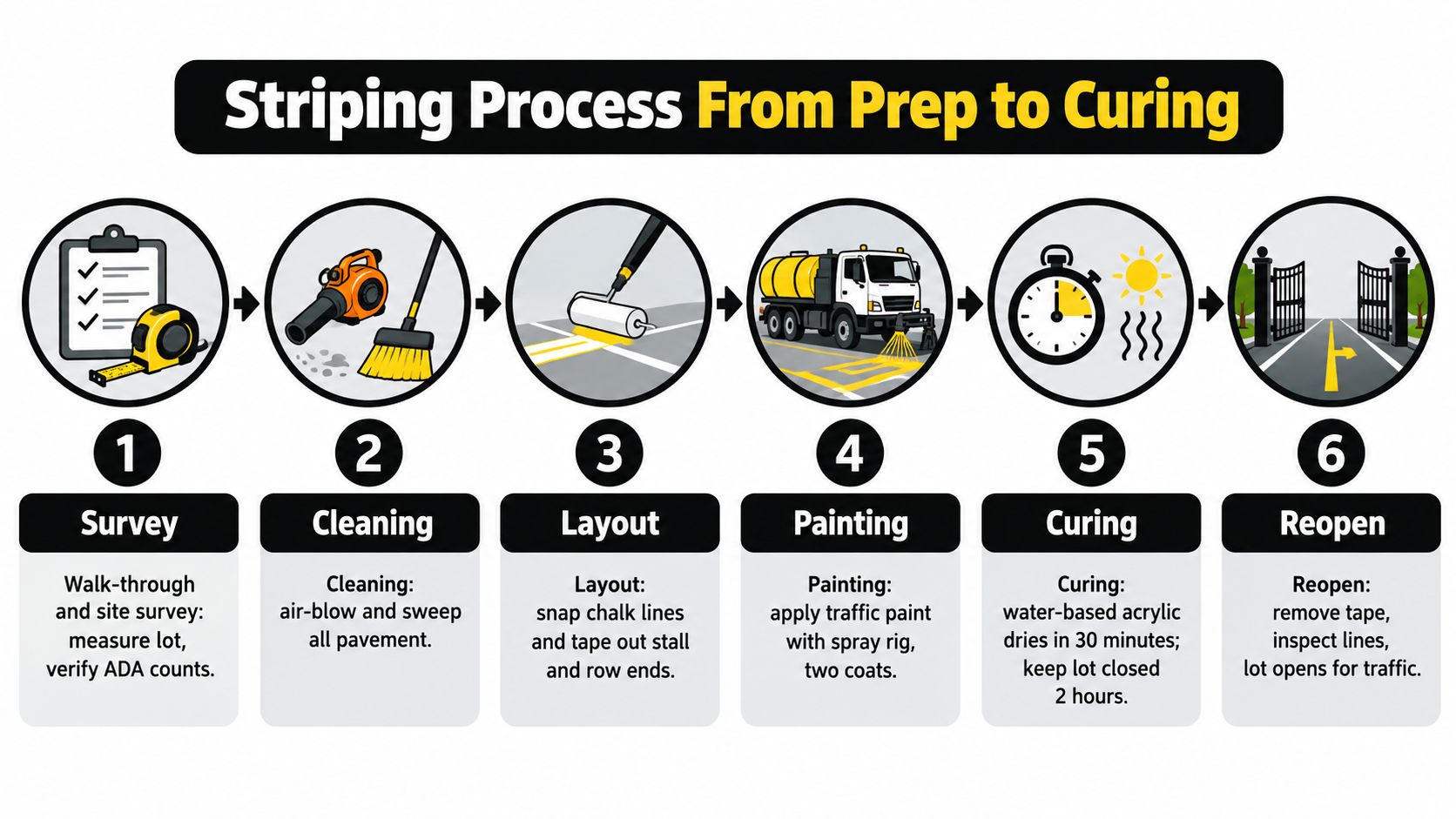
A professional striping day begins before paint touches pavement. The crew walks the site, measures rows, verifies accessible-space counts, checks the pavement, identifies oil or grease contamination, and confirms where vehicles and pedestrians will move during the work.
Six stages on site
Survey: The contractor confirms dimensions, row ends, aisle relationships, symbols, arrows, fire lanes, and the approved scope.
Cleaning: Crews air-blow, sweep, and degrease as needed. Dust, loose aggregate, oil, and debris can weaken adhesion and create rough edges.
Layout: Workers snap chalk lines, use templates, and tape row ends and symbols. A calibrated line machine helps maintain consistent 4-inch stripes.
Application: The crew applies the selected traffic paint with controlled passes. Stencils, arrows, crosswalks, and accessible symbols follow the layout rather than being placed by eye.
Curing: The surface stays closed while the paint dries and develops enough resistance for traffic. Chemistry, humidity, shade, pavement temperature, and film thickness all affect the reopening decision.
Inspection: The crew removes tape, checks edges and symbols, collects cones, and walks the finished area with the manager before reopening.
The exact crew size and duration depend on lot size, access, preparation, and the number of markings. The manager's main responsibilities are to provide the approved layout, arrange access, notify tenants or residents, and keep vehicles out of the work zone. Good contractors handle cones, wet-edge control, overspray protection, and staged reopening.
Don't confuse dry with ready
DFW summer heat can make the surface feel dry quickly while the coating still needs more time before turning traffic loose. The supplied process reference describes water-based acrylic as drying in 30 minutes and recommends keeping the lot closed for 2 hours, but the contractor should make the final decision based on product instructions and actual site conditions. Opening early can drag tires through lines, transfer paint onto wheels, and force a return visit.
Sealcoating requires its own curing plan. Striping over uncured sealcoat can produce poor adhesion and premature failure, so the schedule should place markings only after the surface is ready.
Choosing the Right Striping Contractor
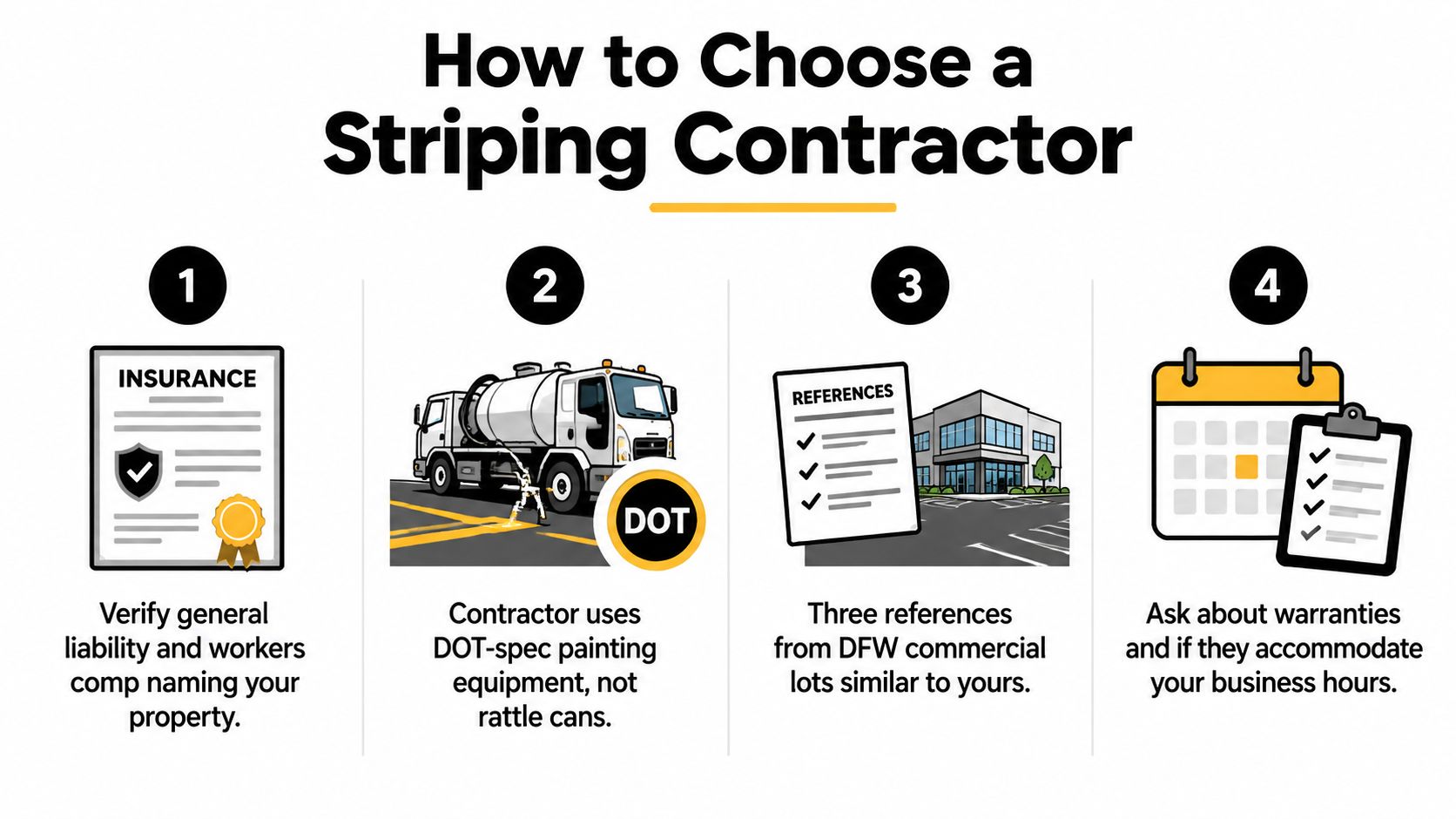
A contractor's equipment and paperwork tell you more than a polished sales pitch. Request a certificate of general liability and workers' compensation insurance, with the property properly identified where required. Ask for references from comparable DFW properties, such as grocery-anchored centers, medical offices, apartment communities, or industrial sites.
Compare scopes, not slogans
Confirm that the crew understands MUTCD conventions, ADA layouts, sealcoat sequencing, and active-lot traffic control. A written scope should identify:
- Paint system: State the product category, color, application method, and whether reflective beads are included.
- Geometry: List stall dimensions, line width, row layout, accessible spaces, van spaces, aisles, and symbols.
- Markings: Identify arrows, crosswalks, stop bars, fire lanes, curb painting, words, and border lanes.
- Preparation: Explain sweeping, degreasing, removal of failed markings, repairs, and sealcoat coordination.
- Warranty: State what peeling or fading is covered, for how long, and what site conditions exclude coverage.
- Traffic plan: Define closures, cones, after-hours access, tenant communication, and the process for correcting rework.
DOT-spec painting equipment matters because a dedicated spray rig and calibrated striping machine produce cleaner, more consistent lines than improvised tools or rattle cans. Equipment alone doesn't guarantee quality, but vague answers about equipment usually signal a vague process.
Ask one direct question: If the layout changes after the first review, who documents the revision and who pays for the correction?
Red flags include door-to-door pricing, a one-line quote with no measurements, no local address, cash-only demands, missing insurance, and refusal to walk the lot before bidding. A short pre-bid walkthrough lets every contractor price the same scope. It also reveals whether they notice drainage, pavement failure, accessible-route problems, and traffic conflicts before they talk about paint.
Maintenance, Re-Striping Schedules, and Final Takeaways
Striping belongs on the same lifecycle calendar as sweeping, crack filling, sealcoating, and pavement repairs. The right schedule depends on traffic, sun exposure, paint chemistry, surface condition, and how the property sequences its work. A busy retail lot in full DFW sun won't behave like a lightly used shaded office lot.
Recent guidance commonly recommends repainting every 12 to 18 months or immediately after sealcoating, while another 2026 guide recommends refreshing lines when visibility falls below 50% and inspecting annually after winter. Those recommendations come from the referenced maintenance guidance, and they should be adjusted to actual field conditions rather than followed as an automatic timer. See the parking lot striping maintenance guidance.
Build the calendar around pavement work
A practical maintenance plan has three layers:
- Inspect: Walk the lot in spring and fall, checking stall lines, arrows, symbols, crosswalks, curbs, fire lanes, and accessible routes.
- Repair: Complete crack filling, patching, cleaning, or sealcoating before final markings go down.
- Refresh: Re-stripe after sealcoat curing and whenever visibility, geometry, or accessible-space counts no longer support safe operation.
For many commercial properties, sealcoating and striping are coordinated over a 24 to 36 month pavement cycle, with markings scheduled after the sealcoat has cured. Water-based paint may need more frequent attention in exposed, heavily used areas, while more durable systems can extend the interval. The contractor should specify the product's expected service conditions instead of promising a universal lifespan.
Exterior maintenance also affects broader property perception. Research on Australian commercial buildings has examined how routine maintenance frequency and upkeep practices influence asset value and market perceptions, supporting the practical view that cleaning and upkeep protect commercial worth, not just appearance. Review the Frontiers commercial-building maintenance study.
For DFW owners, the strongest approach is steady planning. Verify accessible counts by facility, measure before bidding, schedule preparation correctly, use traffic-rated materials, and document each inspection. Rising attention to compliance and the wider use of durable marking systems make reactive repainting a poor long-term strategy. A maintained lot protects circulation, tenant presentation, accessible parking, and the value created by other exterior services, including power washing for concrete, sidewalks, driveways, and building surfaces.
Water Works Power Washing provides Dallas–Fort Worth commercial parking lot striping and re-striping, including arrows, accessible symbols, fire lanes, and border markings, along with residential and commercial power washing for concrete and exterior surfaces. Review the service options and request a project-specific estimate by visiting Water Works Power Washing.